
The tech landscape has experienced an unprecedented paradigm shift. While traditional machine learning once demanded PhD-level mathematical research and complex model training from scratch, the modern software industry has birthed a brand-new high-leverage role: The AI Engineer.
In 2026, companies are no longer asking “Can you train a custom neural network from scratch?” Instead, they are urgently asking: “Can you integrate foundation models into our software stack, orchestrate multi-agent workflows, connect private enterprise data securely, and deploy resilient, cost-effective AI systems?”
Whether you are a backend developer, frontend specialist, cloud architect, or ambitious student, this comprehensive guide delivers the exact AI Engineer Roadmap for 2026—covering core foundations, modern architectures, must-have tools, portfolio projects, and salary benchmarks.
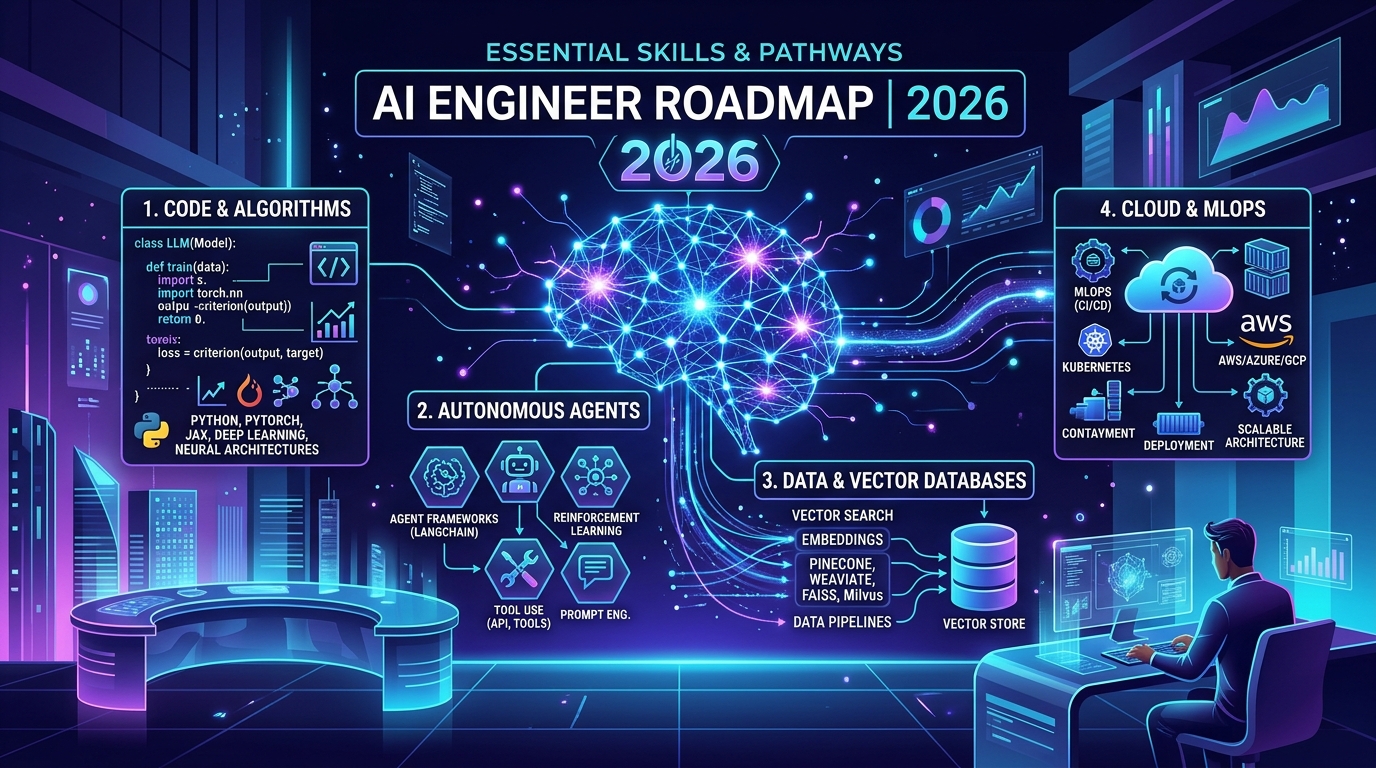
What Exactly Does an AI Engineer Do?
To succeed on this path, you must understand the distinction between three related yet very different titles:
- AI Researcher: Inventing novel mathematical algorithms, architectures, and loss functions (e.g., at OpenAI, DeepMind, Anthropic).
- ML / Data Scientist: Training statistical models, cleaning massive datasets, tuning hyperparameters, and running feature engineering.
- AI Engineer (Application Builder): Utilizing pre-trained frontier LLMs, multimodal APIs, vector databases, and agent frameworks to build scalable, production-grade applications.
Because AI Engineers work primarily with APIs, embeddings, and context engineering, strong software engineering skills (Python, API design, async handling, caching, system design) are vastly more critical than deep theoretical calculus.
Phase 1: Software & Language Foundations
Before diving into LLMs and agents, you must possess rock-solid programming habits:
1. Modern Python Proficiency
Python remains the undisputed language of artificial intelligence. Target mastery in:
- Asynchronous Programming: Utilizing
asyncioandaiohttpfor concurrent model calls and streaming tokens. - Data Validation & Typing: Structuring API schemas with Pydantic v2 (essential for structured outputs).
- Environment & Dependency Management: Using modern fast package managers like uv or Poetry.
2. Backend API Architecture
Your AI models must communicate with client applications. Master building high-throughput microservices using FastAPI with Server-Sent Events (SSE) for real-time response streaming.
Phase 2: Frontier Models & Advanced Prompt Engineering
Foundation models are non-deterministic reasoning engines. Working with them requires precise communication techniques:
- Model Selection Strategy: Knowing when to deploy ultra-reasoning models (OpenAI o3/o1, Claude 3.7 Sonnet) versus fast, lightweight inference engines (Llama 3.3 8B, Gemini Flash).
- Structured Outputs: Forcing LLMs to return strict, validated JSON objects via Function Calling / Tool Calling rather than unstructured free-form text.
- Chain-of-Thought (CoT) & Reflection: Guiding models through explicit intermediate thinking steps to eliminate hallucination in complex calculations or logic.
Phase 3: Retrieval-Augmented Generation (RAG) Mastery
Standard LLMs possess knowledge cutoff dates and zero visibility into your company’s proprietary data. RAG bridges this gap by dynamically feeding relevant external documents into the model’s context window.
The 2026 Production RAG Stack:
| Component | Industry Standard Tools | Key Architectural Concept |
|---|---|---|
| Chunking & Ingestion | LlamaIndex, Unstructured.io | Semantic chunking, recursive character splitting |
| Vector Databases | Qdrant, Pinecone, pgvector (PostgreSQL), Milvus | HNSW indexing, metadata filtering, cosine similarity |
| Hybrid Search & Re-ranking | BM25 + Dense Vectors, Cohere Rerank | Combining lexical keyword search with deep semantic matching |
Phase 4: Autonomous Agents & Multi-Agent Orchestration
The biggest frontier in 2026 is Agentic AI. An agent is an LLM endowed with:
- Memory: Short-term conversation history and long-term vector memories.
- Planning: Breaking down broad goals into ordered execution subtasks.
- Tool Use: Searching the web, querying SQL databases, reading files, and executing code.
Key Frameworks to Master:
- LangGraph: State machine-based cyclical workflows for deterministic and multi-step agent graphs.
- CrewAI: Collaborative role-based multi-agent teams (e.g., Planner agent, Researcher agent, Writer agent, Reviewer agent).
- Model Context Protocol (MCP): The emerging universal open standard allowing AI agents to plug securely into databases, file systems, and enterprise APIs.
Phase 5: LLM Evaluation, Guardrails, and Observability (LLMOps)
Anyone can build a fragile demo in 15 minutes. Professional engineers build reliable systems that withstand production loads without breaking or leaking secrets.
- LLM Evaluations (Evals): Automated benchmarking with tools like DeepEval, Ragas, and LangSmith to ensure prompt tweaks do not degrade performance.
- Security & Guardrails: Protecting against prompt injections, jailbreaks, and sensitive data leakage using frameworks like NeMo Guardrails or Llama Guard.
- Local & Cost-Effective Inference: Deploying open-source models (DeepSeek, Llama, Mistral) on-premise using high-throughput inference engines like vLLM or Ollama to cut cloud API bills by 80%.
Top 3 Portfolio Projects That Land 6-Figure Offers
Generic chatbot clones no longer impress hiring managers. Instead, build and deploy these high-impact projects:
- Enterprise RAG Documentation Intelligence: An end-to-end service parsing complex PDFs and Notion workspaces, employing hybrid BM25 + vector search with Cohere re-ranking, source citations, and sub-second streaming answers.
- Autonomous Multi-Agent Market Analyst: A team of cooperative agents using LangGraph that scrapes competitor pricing, executes statistical sentiment analysis, and formats an executive summary briefing.
- Local Self-Hosted LLM API Service: A containerized Docker application running a quantized open-source model with vLLM, exposed via FastAPI, equipped with latency tracing and automated safety guardrails.
Salary Outlook & Career Potential (2026)
Demand for skilled AI engineers continues to outpace qualified supply:
- United States: $135,000 – $240,000+ base salary plus equity.
- India: ₹18 LPA – ₹55+ LPA for mid-to-senior engineers with proven GenAI production experience.
- Remote Global: Top-tier global contracts frequently exceed $100/hr for specialized agentic workflow architects.
Frequently Asked Questions (FAQ)
Do I need a PhD or advanced math degree to become an AI Engineer?
No. AI engineering is centered around software engineering, API integration, context management, and system architecture. While a basic grasp of linear algebra and statistics is helpful, deep research mathematics is only required for foundational model pre-training.
Should I learn LangChain or build with raw API calls?
Start by mastering direct SDK calls (OpenAI/Anthropic/Google APIs) to understand raw JSON payloads and streaming. Once confident, leverage higher-level orchestration tools like LangGraph or LlamaIndex for complex state machines and multi-step workflows.
How long does it take to transition into AI Engineering?
For an existing software developer, dedicating 10–15 hours per week typically yields strong job readiness within 3 to 5 months of hands-on project building.
Ready to Accelerate Your Tech Career?
Stay tuned to IT2EDU for comprehensive guides, practical code tutorials, and deep dives into AI engineering, cloud computing, and modern software development.
